
Saw Palmetto: Effects and Uses
Leila WehrhahnUpdated:Key points at a glance:
Saw palmetto (Serenoa repens) is a palm species native to the United States. Its extract is often discussed in connection with the inhibition of 5-alpha reductase and a possible reduction of DHT levels by around 15 to 30 percent. It is commonly used in relation to symptoms of benign prostate enlargement and androgenetic hair loss. A typical intake in studies is 320 mg daily as a standardised extract containing 80 to 95 percent free fatty acids. Effects are usually reported after 4 to 6 weeks, and for hair-related outcomes after around 3 to 6 months. PSA levels may decrease. It is not recommended during pregnancy. Caution is advised when used alongside blood-thinning medications.
What is saw palmetto?
Saw palmetto, also known by its English name saw palmetto or its botanical term Serenoa repens, is a low-growing palm species that is mainly found in the south-eastern United States, particularly Florida. Its fruits have been used for centuries in traditional medicine by Native American communities and are now widely included in food supplements.
But what exactly is saw palmetto, what is saw palmetto used for and how is it thought to work in women and men? This article explains, on the basis of current research, the key facts, the state of the science and possible areas of use for saw palmetto extract.
What you will learn in this article:
- What saw palmetto (Serenoa repens) is and where it comes from
- What saw palmetto is commonly used for and how saw palmetto extract acts biochemically
- Different potential effects and uses in women and men
- Scientific evidence: what studies actually show
- How saw palmetto is used in food supplements
- Important safety information, risks and interactions
Saw palmetto (Serenoa repens) is a species of palm tree native to the United States. Its extract inhibits DHT formation and is traditionally used for prostate health, hormonal balance and hair loss. Moderate scientific evidence supports various applications.
What is saw palmetto? Botanical basics
Saw palmetto (Serenoa repens) is a small, shrub-like palm from the Arecaceae family. It grows mainly in:
- Florida
- Georgia
- South Carolina
- Other south-eastern US states
The plant produces dark red to black berries, from which the extract used in supplements is obtained.
Constituents of saw palmetto extract
Saw palmetto extract is obtained from the dried fruits and contains a complex mixture of bioactive substances:
- Free fatty acids: 70–95% (lauric acid, myristic acid, oleic acid, palmitic acid)
- Phytosterols: Especially β-sitosterol (0.1–0.3%)
- Other components: β-carotene, vitamin E derivatives, polysaccharides
These constituents are thought to be responsible for its biological activity. Important: The quality and potential efficacy depends strongly on standardisation of the extract – higher-quality preparations typically contain 80–95% free fatty acids.
How does saw palmetto work? Mechanisms in the body
Saw palmetto extract has been studied for several biochemical mechanisms, all of which are linked to the hormone dihydrotestosterone (DHT).
The central mechanism: 5-alpha-reductase inhibition
The main proposed mechanism of saw palmetto is the inhibition of the enzyme 5-alpha-reductase. This enzyme converts testosterone into the more potent dihydrotestosterone (DHT). DHT is discussed in relation to:
- Prostate enlargement (benign prostatic hyperplasia)
- Androgenetic alopecia (pattern hair loss)
- Sebum production in the skin
Saw palmetto appears to act as a competitive, non-selective inhibitor of both 5-alpha-reductase isoforms (type 1 and 2). Studies report:
- 15–30% reduction in serum DHT levels
- Approximately 50% reduction in DHT binding to androgen receptors
- Reduced nuclear uptake of DHT into cells
Additional mechanisms
In addition to DHT modulation, saw palmetto has been investigated for further effects:
- Anti-inflammatory properties: Reduction of pro-inflammatory cytokines (IL-6, TNF-α) in experimental models
- Support of blood flow: β-sitosterol has been associated with stimulation of vascular endothelial growth factor (VEGF)
- Increase in 3α-hydroxysteroid dehydrogenase: Converts DHT into weaker metabolites
Saw palmetto extract inhibits the enzyme 5-alpha reductase, thereby reducing DHT by 15-30%. This explains its effect on prostate problems, hair loss and hormonal imbalances. Saw palmetto also has anti-inflammatory properties..
What is saw palmetto used for? Areas of application
Based on its proposed mechanisms and clinical studies, saw palmetto is used in several contexts:
1. Prostate health (main use in men)
Benign prostatic hyperplasia (BPH):
- Most common use: urinary symptoms associated with an enlarged, non-cancerous prostate
- Studies report a moderate improvement in urinary flow symptoms in some men
- Effects have been described as similar to those of lower-dose pharmaceutical options, but weaker than high-dose medicines
- Typical dosage: 320 mg daily
2. Hair loss (men and women)
Androgenetic alopecia:
- In one study, 38% of men showed improvement after 2 years (vs. 68% with finasteride)
- Some research reports a 27% increase in hair count and an 83.3% increase in hair density
- The effect seems to be more noticeable at the crown than at the frontal hairline
- Both oral and topical applications have been investigated
- More details in our article: Saw palmetto for hair loss
3. Hormonal balance (particularly in women)
Hormone-related complaints:
- Sometimes used in relation to hormone-related skin issues (acne, excessive sebum production)
- Possible support in polycystic ovary syndrome (PCOS) has been discussed – evidence is limited
- Occasionally used during the menopause, but scientific data are still insufficient
4. Skin, hair and nails
Due to its influence on DHT and potential anti-inflammatory properties:
- Is sometimes used in products aimed at oily skin and blemishes
- Is associated with general support for hair condition
- Is a regular component of many food supplements marketed for skin, hair and nails
👉Insider tip: In Nordic Oil Essentials Skin, Hair & Nails gummies, saw palmetto extract is combined with additional nutrients.
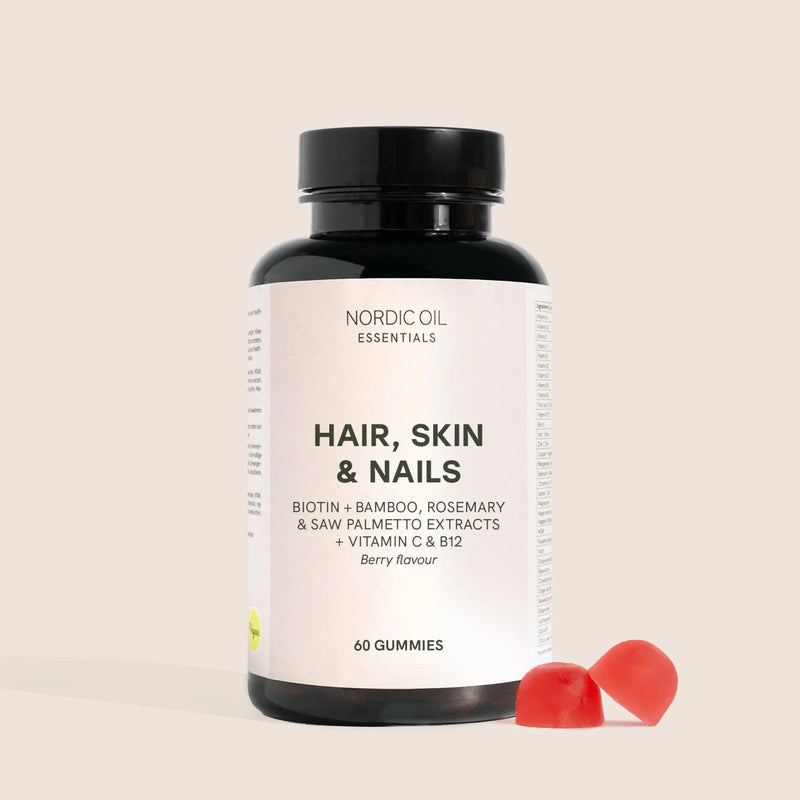
Hair Skin and Nails Gummies
Conclusion: what we really know about saw palmetto
Saw palmetto (Serenoa repens) is a well-studied plant extract with moderate scientific evidence supporting its use in several areas.
What is supported by research:
- ✅ DHT reduction: 15–30% decrease through 5-alpha-reductase inhibition has been reported
- ✅ Prostate symptoms: moderate improvement in BPH-related urinary complaints in many studies
- ✅ Hair loss: 38% improvement in men in one trial, 27% more hairs, 83.3% higher hair density in reviews
- ✅ Safety: generally well tolerated, with fewer side effects than many pharmaceutical treatments
- ✅ Appears to act in both sexes in the context of hair loss
What is limited or unclear:
- ⚠️ Less potent than pharmaceuticals: roughly half as strong as finasteride in some studies
- ⚠️ Patience needed: 3–12 months until the full effect is apparent
- ⚠️ Women: fewer study data, caution needed regarding pregnancy and contraception
- ⚠️ Individual variation: it does not work equally for everyone
- ⚠️ Long-term data: limited beyond 2 years
Evidence-based practical guidance:
- For BPH (prostate): saw palmetto can be a reasonable plant-based option, particularly in early stages, as part of a plan agreed with a healthcare professional
- For hair loss: a possible choice for mild to moderate cases, or as an add-on to other approaches
- For those at higher perceived risk: early use is sometimes considered when there is a family tendency to pattern hair loss or prostate enlargement
- Focus on quality: choose only standardised extracts (80–95% fatty acids) in softgel form
- Be consistent: continue for at least 6 months before assessing personal benefit
- Safety: inform your doctor about use (especially for PSA testing, blood thinners, and before operations)
- Combination: consider pairing with biotin, pumpkin seed oil or other nutrients where synergistic effects are being studied
The key message
Saw palmetto is not a miracle cure, but it is a plant-based option with a solid, though moderate, scientific foundation. Its effects tend to be moderate, with a relatively favourable safety profile – which may appeal to people seeking a gentler alternative to, or addition to, pharmaceutical treatments.
The evidence is strongest for its use in prostate health and hair loss in early to moderate stages. In more advanced cases, pharmaceutical options are often more effective and should be discussed with a healthcare professional.